

IMF reaches agreement with Argentina on loan programme review
The International Monetary Fund (IMF) has reached a staff-level agreement with Argentina on the latest review of its US$20-billion loan programme, paving the way for a fresh US$1-billion payout.
In a statement, the IMF confirmed the deal with President Javier Milei’s government following the second review of their 48-month Extended Fund Facility (EFF) agreement.
The new tranche – the third under the programme approved in April 2025 – still requires sign-off from the IMF’s Executive Board.
The review process had dragged on for months, with staff last visiting Buenos Aires in early February.
If the staff report is approved by the IMF’s board, Argentina would receive a US$1-billion disbursement, taking the total released through the deal to US$15 billion.
The country begins principal repayments in September under its prior agreement with the lender.
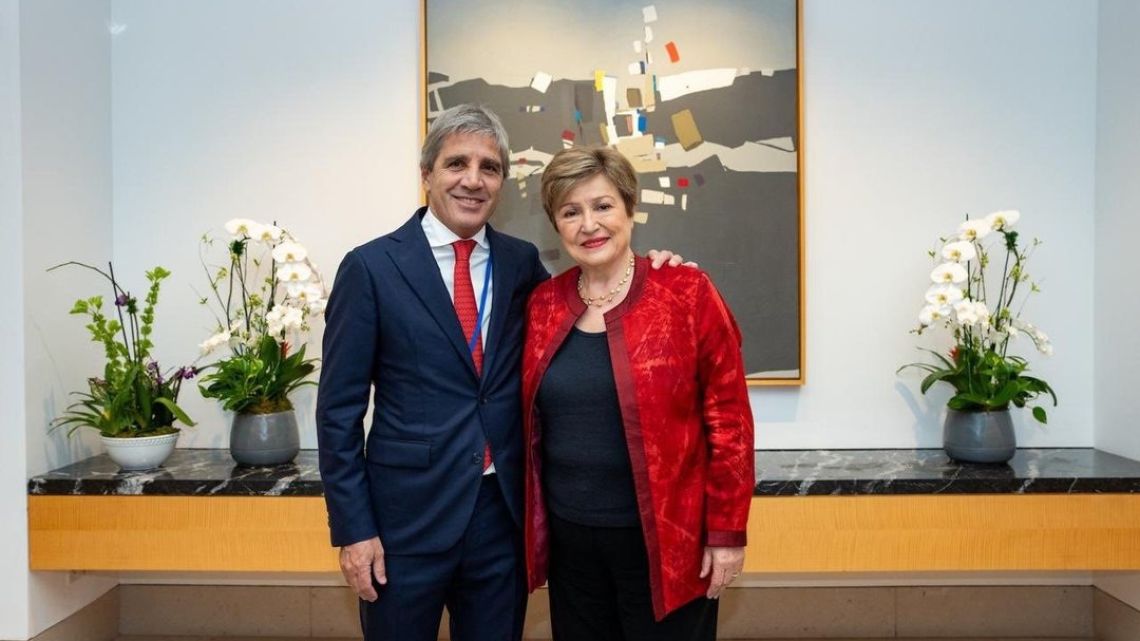
Economy Minister Luis Caputo, who travelled to Washington for the IMF’s Spring Meetings this week, described the deal as a “very important step.”
He thanked Managing Director Kristalina Georgieva for her “leadership and commitment” throughout the process.
“This agreement is a very important step in consolidating the macroeconomic stability we have been working towards over the past two years, and it will help to strengthen our country’s economic growth,” Caputo said.
Argentina has managed “to weather spillovers from the Middle East war well,” the IMF said in its communiqué. “Policy momentum has strengthened in recent months with congressional approval of the 2026 Budget and critical reform legislation,” said the IMF.
Monetary and exchange rate policies are “improving Argentina’s capacity to manage shocks,” it added.
“Building on impressive stability gains, understandings were reached on a strong and balanced policy package aimed at entrenching disinflation, external stability, and growth, thereby supporting timely and sustainable market access,” the statement read.
Praising the Milei administration, the IMF pointed to “strong and constructive engagement” with authorities and their continued commitment to the programme, including corrective measures to address earlier setbacks.
The announcement offers relief to the government, coming a day after March inflation data showed consumer prices rose 3.4 percent – the highest monthly reading in a year.
Milei has slashed annual inflation from 117 percent in 2024 to 31 percent in 2025, though progress has stalled since mid-2025.
Argentina posted a fiscal surplus in 2025 and, after securing improved representation in Congress in last October’s midterm elections, Milei has pushed forward with reforms, including changes to labour laws.
The exchange rate – with a strong peso against the US dollar, at 1,385 pesos at the official rate – has encouraged imports, which the government has boosted through deregulation policies.
A surge in imports, mainly from China, has helped bring down prices but has also weighed on national industry, which recorded an 8.6 percent year-on-year drop in February.
The IMF anticipates lower growth this year than in 2025 – 3.5 percent compared to 4.4 percent in 2025. Inflation is forecast at around 30 percent.
The Fund said that it had agreed with Argentina on a series of additional reforms “to entrench the impressive stabilisation gains and sustained reductions in poverty levels since end-2023.”
Argentina’s economy expanded last year, after two years of contraction.
However, growth was uneven, with some sectors – such as financial services, agriculture and mining – expanding, while others – like manufacturing and retail trade – slowed.
Unemployment remains concerning, increasing by 1.1 percentage points to 7.5 percent over the past year, not including the large number of people informally employed across the country.
“The chainsaw will not stop,” Milei said in a speech on Tuesday, referring to his fiscal austerity drive. He said that he would “remove all pesos from circulation until the inflation rate collapses” and “continue opening up the economy.”
Argentina returned to international debt markets in December, issuing foreign-currency bonds after more than seven years.
“Net international reserves are projected to increase by at least US$8 billion in 2026,” the IMF said.
The country has defaulted several times, twice this century – in 2001, amid a social upheaval that left 39 dead, and again in 2020 during the Covid-19 pandemic.
Relations with the IMF have long been strained, marked by protracted negotiations to resolve arrears.
– TIMES/AFP/NA
COMENTARIOS