

Europa and the bullies | Buenos Aires Times
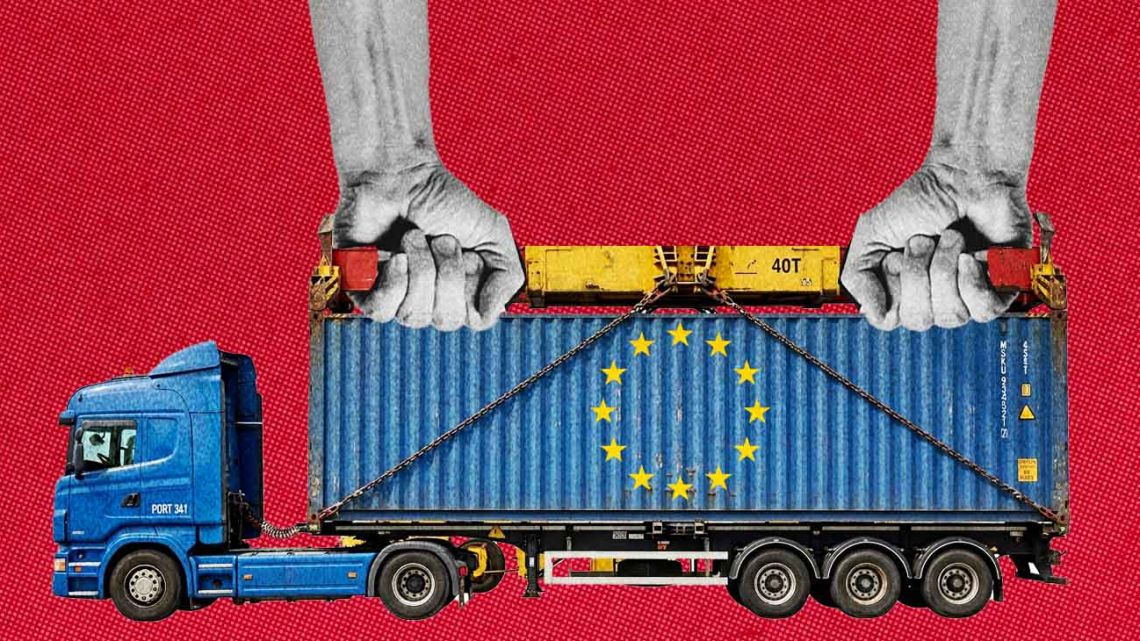
Today is Schuman Day or Europe Day, the most important date in the calendar for the European Union commemorating the historic Schuman Declaration of 1950 in which French Foreign Minister Robert Schuman (not to be confused with the composer) proposed the subcontinental pooling of coal and steel resources, thus laying the foundation for what would become today’s gigantic bloc of 27 countries with over 450 million people. Already reason to make it the subject of a column seeking to broaden the field beyond the week’s main news (which does not seem much more than Adorni-bashing) but the start of this month saw the EU-Mercosur agreement ratified by Congress here last February kicking in with Argentina’s first shipments of duty-free honey already on their way to Germany.
A success story since the devastated post-war continent of 1950 with German sovereignty only recently regained, Europe has been in decline for some time even preceding Brexit in 2016 – indeed there is a case for saying that Europe paradoxically began to contract soon after its greatest expansion in 2004 with the entry of 10 countries totalling 74 million inhabitants, never really getting over the PIGS (Portugal, Italy/Ireland, Greece, Spain) financial crisis of 2008. Speaking at the Book Fair last weekend, the Spanish author Arturo Pérez-Reverte spoke of a Europe admired for centuries as a model for others now being despised by the rest of the world – by the current White House because its prevailing social market economy is seen as diluting capitalism while a nominally Communist China feels that its rise to superpower status is proof positive that democracy is an obstacle for capitalism. Two bullies against whom Europe looks for support elsewhere in the world, such as the Southern Cone.
But misery is said to love company – South America does not rate all that high globally either. For various reasons – arguably the world’s most acute income inequality with a vast gap between rich and poor along with low social mobility, a technological lag with insufficient importance attached to education and research & development, a resulting lack of industrial development with a focus on primary resources dating all the way back to the Spanish colonial obsession with gold, while the manufacturing sector is all too often a protected import substitution with low productivity and a share of world trade halved during this century, not to mention a history rife with political instability.
Two regions with problems big enough to convince both blocs of the necessity for an agreement after a quarter-century of negotiations – Mercosur had the idea almost at birth in 1991, both sides basically had their offers on the table by 2004 and in mid-2019 then-president Mauricio Macri had every reason to consider the pact a done deal with the commercial aspects pretty much sorted out, only for environmental objections to arise from a Europe then in the final stages of inking its Green Deal. But this year and this month finally sees a massive free-trade agreement covering some 700 million people come provisionally into being – deserving that description because it eliminates tariffs on 91 percent of EU goods while opening European markets to South American farm produce.
But also deserving that adverb “provisionally” – the full agreement still awaits final ratification by all individual EU parliaments while the European Court of Justice has yet to evaluate and approve the deal. Quite apart from the clout of the French, Polish, Irish and many other farming lobbies to hinder that parliamentary ratification, other spanners lurk in the works such as the environmental groups concerned over deforestation and pesticides. Some have arisen since the deal was sealed early this year such as last month’s amendments to the Glaciers Law, which Europe might view as lowering the environmental bar beyond what was agreed – this against a backdrop of chronic European doubts about this region’s concern over a climate change explicitly denied by President Javier Milei (far from going unnoticed by the EU).
Furthermore, the EU-Mercosur pact directly clashes with the almost simultaneous Agreement on Reciprocal Trade and Investment (ARTI) with the United States on at least one point – geographical indications. The ARTI spells out: “Argentina has also committed itself to applying rigorous standards of transparency and equity respecting the protection of geographical indications while guaranteeing that US products may continue using terms which have been unfairly protected as geographical indications.” In other words, US products are given every right to use such “unfairly protected terms” as Parmesan ham or cheese or whatever without coming from anywhere near the Po Valley while the EU-Mercosur agreement mandates the protection of EU geographical indications covering European wines, cheeses, etc. in the Mercosur market.
The two above agreements (with Argentina not the only US partner) are perhaps the only responses this century from the rest of the world to the steady rise of Chinese influence in Latin America, especially trade and investment – much too early days to see how a China now giving top priority to its oil supplies with the Strait of Hormuz blocked is going to react but react it almost certainly will. Quite apart from China, Mercosur countries might be apprehensive over whether hitching too closely to EU standards may not prove a stumbling-block to free-trade agreements with countries across the world, an area where they are seriously lagging.
The devil lies in the detail and this agreement will stand or fall on its nuts and bolts, for which this is neither the space nor the time – this column does not even have the space to explore such major sectors as the auto industry or the grain trade, never mind more specific ítems such as eggs or sugar which are also essential for a comprehensive analysis. There will be multiple winners and losers from this agreement but far too early days to identify them – the proof will be in the pudding.
Impossible to improve on the generalisations presented here except perhaps at the institutional level where things may be abstract enough to permit general conclusions. This is one area where the two blocs can learn from each other – Mercosur how to evolve the currently lacking institutional architecture with no conflict resolution mechanism beyond presidential summits and Eurocracy how it can move away from the image of Brussels leading to Brexit as élitist bureaucratic overreach at odds with democracy, an easy prey for demonisation by populists and nationalists as a threat to national sovereignty and traditional values.
All points to ponder on Europe’s first Schuman Day with a Mercosur partner.
related news
COMENTARIOS